FORMS WE CAN PROVIDE

Copper-Nickel(Cu70Ni30) Alloy

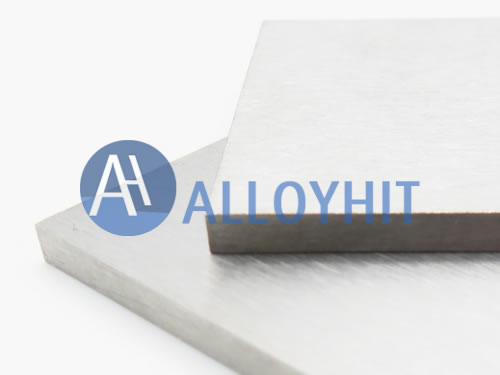
Copper 70 Nickel 30 alloy (C71500, also known as Cu70Ni30) is an alloy with copper as the matrix (70%), Nickel as the main alloying element (30%), and small amounts of iron (1.0~2.0%) and manganese (1.0~2.0%).
The performance of Copper70Nickel30(Cu70Ni30) Alloy is determined by the synergistic effect of copper and nickel: copper imparts excellent electrical and thermal conductivity, as well as workability, while nickel significantly enhances corrosion resistance (especially resistance to seawater and chloride ion corrosion), strength, and low-temperature toughness. The combination of copper and nickel in a 7:3 ratio creates a unique combination of "seawater corrosion resistance, excellent electrical properties, and stable mechanical performance," making Copper70Nickel30(Cu70Ni30) Alloy a key material in fields such as marine engineering, precision electronics, and shipbuilding, and is widely used in applications requiring both corrosion resistance and functionality.

Product of Cu70Ni30
Cu70Ni30 Foil Cu70Ni30 Wire Cu70Ni30 Sheet
Cu70Ni30 Rod Cu70Ni30 Tube Cu70Ni30 Ingot

Composition of Copper70Nickel30(Cu70Ni30) Alloy

The precise composition of our Copper-Nickel 70/30 alloy delivers a unique combination of properties ideal for diverse industrial applications.

Copper (70%)
Nickel (30%)
Manganese (Mn) ≤1%

Key Constituents

Copper (Cu)
70%
Nickel (Ni)
30%
Manganese (Mn)
≤1%
Iron (Fe)
≤0.5%

Composition Benefits

Core Components (by mass)

  • Copper (Cu): 68%-72%(matrix element, determines electrical conductivity, thermal conductivity, and basic workability);
  • Nickel (Ni): 28%-32% (key alloying element, dominant for corrosion resistance, strength, and low-temperature stability);
  • Trace Alloying Elements: Typically, 0.5%-1.0% iron (Fe) and 0.1%-0.5% manganese (Mn) are added. Iron further enhances resistance to seawater corrosion, while manganese optimizes the alloy's melt flowability and reduces casting defects;
  • Impurity Control: Impurities such as lead (Pb ≤ 0.05%) and sulfur (S ≤ 0.01%) are strictly limited to avoid compromising toughness and corrosion resistance;

Material Properties of Copper70Nickel30(Cu70Ni30) Alloy

Copper70Nickel30(Cu70Ni30) exhibits a unique combination of physical and mechanical properties that make it suitable for challenging environments.

Melting Point 1240-1270°C

It is much stronger than aluminum alloys (600~700°C) and can withstand high-temperature conditions (such as boiler pipes).

Density 8.94 g/cm3

Slightly heavier than stainless steel (7.85 g/cm3), but with higher strength, making it suitable for high-pressure loads.

Thermal Conductivity 34 W/m·K

At 20°C (68°F)
Lower than pure copper (401 W/(m・K)), but better than stainless steel (15 W/(m・K)), suitable for equipment that requires uniform heat conduction.

Coefficient of Thermal Expansion 17.8 ×10⁻⁶/°C

From 20-300°C
Similar to carbon steel, it experiences less thermal stress during welding/assembly, reducing the risk of cracking.

Electrical Resistivity 0.23 μΩ·m

At 20°C
Moderate conductivity, suitable for cable shielding in marine environments.

Specific Heat Capacity 385 J/kg·K

At 20°C

Mechanical Properties of Copper70Nickel30(Cu70Ni30) Alloy(Annealed)

Tensile Strength 415~485 MPa

It can withstand the working pressure (≤30MPa) of high-pressure pipelines (such as marine hydraulic systems).

Yield Strength (0.2% offset) 170~205 MPa

After cold working, high-strength bolts and flanges can be manufactured, with strong resistance to deformation.

Elongation 35-40%

In 50 mm (2 in)
Annealed material is easily stamped into complex shapes (such as heat exchanger fins).

Hardness (Brinell) 90-110 HB

500 kg load
It has better wear resistance than pure copper, making it suitable for high-frequency friction components (such as valve cores).

Elastic Modulus 135~145 GPa

Fatigue strength (107 cycles, rotational bending) 200 MPa

Ship propellers have no risk of breakage during long-term rotation.

Advantages of Copper70Nickel30(Cu70Ni30) Alloy compared to similar materials

Material Tensile strength (MPa, cold-worked) Elongation (%, annealed) Main differences
Pure Copper(T2) 310 45~50 Its strength is only 60% of that of Cu70Ni30 Alloy, and its corrosion resistance is poor.
Cu90Ni100 485 30~35 Its strength is about 10% lower than Cu70Ni30 Alloy, and its resistance to high-flow-rate corrosion is weak.
304 Stainless Steel 515 40 The strength is similar, but Cu70Ni30 Alloy has better toughness (no brittleness at low temperature).

Corrosion Resistance Performance of Copper70Nickel30(Cu70Ni30) Alloy

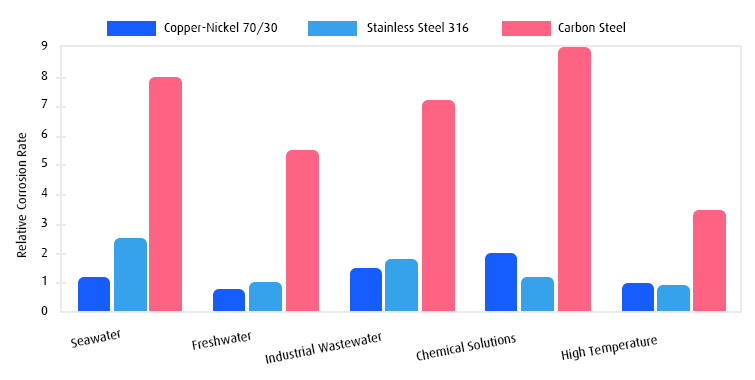
Corrosion Resistance Performance
Relative corrosion rate in various environments (lower values indicate better resistance)

Superior Corrosion Resistance

  1. Superior Seawater Corrosion Resistance: Nearly no pitting or crevice corrosion occurs in still or flowing seawater, tidal zones, and marine atmospheres, with an extremely low corrosion rate (approximately 0.01mm/year), far superior to stainless steel and ordinary brass.
  2. Neutral/Weakly Corrosive Media Resistance: Stable to freshwater, saltwater, organic acids (such as acetic acid), dilute alkalis (such as ammonia), and industrial cooling water.
  3. Anti-Biofouling: The surface is resistant to the adhesion of marine organisms (such as shellfish and algae), reducing maintenance costs for marine equipment.
Applications: It can be directly used for seawater cooling pipes of marine vessels, submarine cable armoring, and water pipelines of offshore platforms, and can serve for a long time without additional anti-corrosion coating.

Electrical and thermal properties

  1. Moderate conductivity: Resistivity is approximately 0.23Ω・mm2/m (lower than pure nickel, higher than stainless steel, and about one-quarter that of pure copper), making it suitable for applications requiring both electrical conductivity and corrosion resistance.
  2. Stable thermoelectric potential: Within the temperature range (-200°C to 300°C), the thermoelectric potential fluctuates minimally, making it a key material choice for precision thermocouples.
  3. Thermal conductivity is approximately 34W/(m・K) (lower than pure copper's 401W/(m・K) and higher than pure nickel's 91W/(m・K)), making it suitable for corrosion-resistant components requiring moderate thermal conductivity.
Applications: Corrosion-resistant terminals for precision electronics, conductive contacts for oceanographic instruments, and protective sleeves for industrial thermocouples (e.g., when measuring the temperature of low-temperature media).

Mechanical and processing properties

  1. Excellent room-temperature strength: Tensile strength of approximately 415-485 MPa, yield strength of approximately 170-205 MPa, higher than that of ordinary brass (e.g., H62 brass has a tensile strength of approximately 330 MPa), and excellent ductility (elongation of approximately 35%-40%).
  2. Outstanding low-temperature toughness: No brittle fracture even at -196°C, and stable impact toughness.
  3. Excellent hot and cold workability: Can be formed into sheets, tubes, and bars through rolling, forging, and stretching, and can also be stamped into complex shapes (e.g., electronic component housings). Excellent weldability (both argon arc and resistance welding are acceptable, with weld corrosion resistance approaching that of the parent material).
Applications: Manufacturing load-bearing corrosion-resistant components, such as the shaft sleeves of ship propellers, valve cores of chemical equipment, and corrosion-resistant pipelines of cryogenic equipment (such as liquid oxygen delivery pipes).

Appearance and stability

  1. It has a silvery-white metallic luster and a high surface finish, and is resistant to discoloration (no patina) even after long-term exposure to the atmosphere.
  2. It exhibits excellent stress relaxation resistance: It exhibits minimal deformation and high dimensional stability even under long-term static loads (such as bolt tightening forces) or high temperatures.
Applications: Used for high-end decorative parts (such as metal guardrails in oceanariums), housings of precision instruments (such as underwater sensor housings), and long-term service fasteners (such as bolts on offshore platforms).

Processing Requirements of Copper70Nickel30(Cu70Ni30) Alloy

Proper handling and processing techniques ensure optimal performance of Copper70Nickel30(Cu70Ni30) Alloy in final applications.

Fabrication Guidelines

Machining

Use high-speed steel or carbide tools with positive rake angles. Coolant is essential to prevent work hardening. Recommended cutting speed: 15-30 m/min (50-100 ft/min) depending on operation.

Welding

Can be welded using TIG, MIG, and submerged arc methods. Use matching Cu-Ni filler metals. Preheating is generally not required, but interpass temperature should be kept below 200°C (392°F).

Forming

Excellent cold forming properties. Hot working can be done between 650-900°C (1200-1650°F). Annealing recommended after heavy cold working at 700-800°C (1290-1470°F).

Cleaning & Finishing

Use mild alkaline cleaners. Avoid strong acids that can cause pitting. Passivation is not required but can be done using nitric acid solutions if needed.

Quality Control Parameters

Chemical Composition ±0.5%
Tensile Strength ±5 MPa
Hardness ±3 HB
Grain Size ASTM 5-8
Surface Finish Ra 0.8-3.2 μm

Heat Treatment Process

ANNEALING
700-800°C
STRESS RELIEVING
300-400°C
SOLUTION ANNEALING
900-950°C

Usage Precautions of Copper70Nickel30(Cu70Ni30) Alloy

Avoid strong oxidizing media

This alloy will be damaged by the surface passivation film in strong oxidizing environments such as concentrated nitric acid, concentrated sulfuric acid (concentration > 70%), and chromic acid, resulting in a sharp decrease in corrosion resistance. Strictly avoid use..

Control the upper limit of high-temperature use

Although the alloy can be used for long periods below 300°C, above 400°C, nickel reacts with oxygen in the air to form nickel oxide, causing surface oxidation and flaking. High-temperature use is recommended to be limited to 350°C.

Post-processing surface treatment

Scratches, oil stains, or scale on the surface during processing may become a starting point for corrosion. Surface repair methods such as pickling (e.g., with dilute nitric acid solution) and polishing are required to ensure corrosion resistance.

Avoid galvanic corrosion with dissimilar metals

Direct contact with metals with lower potentials, such as zinc and aluminum (e.g., in marine environments), can form a galvanic cell, accelerating corrosion of the copper-70 nickel-30 alloy. Insulating gaskets or coatings should be installed on the contact surfaces.

Applications of Copper70Nickel30(Cu70Ni30) Alloy

Discover how industries worldwide are leveraging Copper70Nickel30(Cu70Ni30) Alloy for superior performance in demanding environments.

Engineering

Marine Engineering and Shipbuilding (Core Sector)

The high salinity and humidity of the marine environment place extremely high demands on materials with exceptional corrosion resistance. Copper-70 Nickel-30 alloy is the benchmark material in this field:

  • Marine systems: seawater cooling pipes, condenser heat exchange tubes, propeller sleeves and bushings, valves and pump bodies in ship ballast water systems;
  • Offshore platforms: joints for subsea oil and gas pipelines, impellers for seawater lift pumps, and guardrails and connectors for offshore platforms;
  • Marine exploration: underwater robot housings, sonar system domes, and submarine cable armor (balancing corrosion resistance and protection).
Electronics

Precision Electronics and Instrumentation

Thanks to its combination of electrical conductivity, corrosion resistance, and dimensional stability, this alloy has a wide range of applications in the electronics field:

  • Electronic components: Electronic components: corrosion-resistant terminal blocks, connector contacts, and conductive substrates for printed circuit boards (especially for use in humid or corrosive environments, such as bathroom appliances);
  • Instrumentation: protective tubes for precision thermocouples (measuring range -200°C to 300°C, stable thermoelectric potential), flowmeter detection tubes, and corrosion-resistant pressure gauge cases;
  • Medical electronics: chemical reagent-contacting components in in vitro diagnostic instruments (such as biochemical analyzers) (resistant to reagent corrosion and non-contaminating).
Chemical

Chemical and Energy Industries

This alloy can replace stainless steel or pure copper in corrosive media or under special operating conditions, extending equipment life:

  • Chemical Equipment: Linings for organic acid (such as acetic acid and citric acid) reactors, pipelines for transporting brine or dilute alkaline solutions, and heat exchanger tubes (resistant to alternating hot and cold weather corrosion);
  • Energy Industry: Components of seawater circulation systems in nuclear power plants (resistant to radiation and seawater corrosion to prevent radioactive material leakage), and pipelines for transporting brine in onshore oil and gas production.
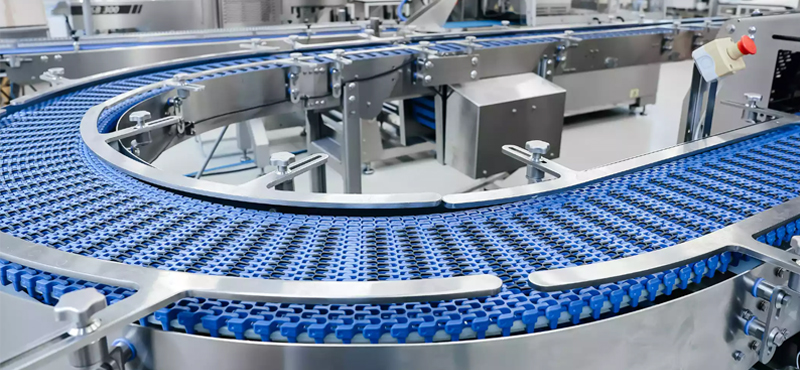
corrosion-resistant conveyor belts

High-End Manufacturing and Decoration Industries

Leveraging its silvery-white appearance and excellent stability, it is also used in applications requiring high aesthetics and durability:

  • High-End Decoration: Metal guardrails and decorative components for aquariums and coastal buildings (patina-free, maintaining a silvery-white luster over time), and metal accessories for luxury goods (such as high-end watch cases and straps);
  • Specialty Components: Corrosion-resistant piping for cryogenic equipment (such as connecting pipes for liquid oxygen and liquid nitrogen storage tanks, with stable low-temperature toughness), and corrosion-resistant conveyor belts for the food industry (no heavy metal precipitation, meeting food safety standards).

Emerging Application Trends of Copper70Nickel30(Cu70Ni30) Alloy

Market Growth Projection

Custom Testing Available

We can provide additional testing and certification as required by your specific application, including fatigue testing, corrosion testing, and more. Please contact us with your specific requirements.