REFRACTORY METAL

Niobium

Niobium has the properties of high melting point, low vapor pressure, good cold working performance, high chemical stability, strong resistance to liquid metal and acid and alkali corrosion, and large dielectric constant of the surface oxide film. It is an important functional material.

Metal niobium has good toughness, elongation and low temperature processing performance, but it has strong chemical activity and high melting point. Its performance is very sensitive to the content of impurities. Nearly several hundred parts per million of oxygen, hydrogen or carbon can make niobium become Hard and crispy. The powder metallurgy method that usually uses vacuum high temperature sintering, electron beam furnace (EB), vacuum consumable electric arc furnace (VAR) vacuum smelting method are common methods for preparing high-purity niobium.

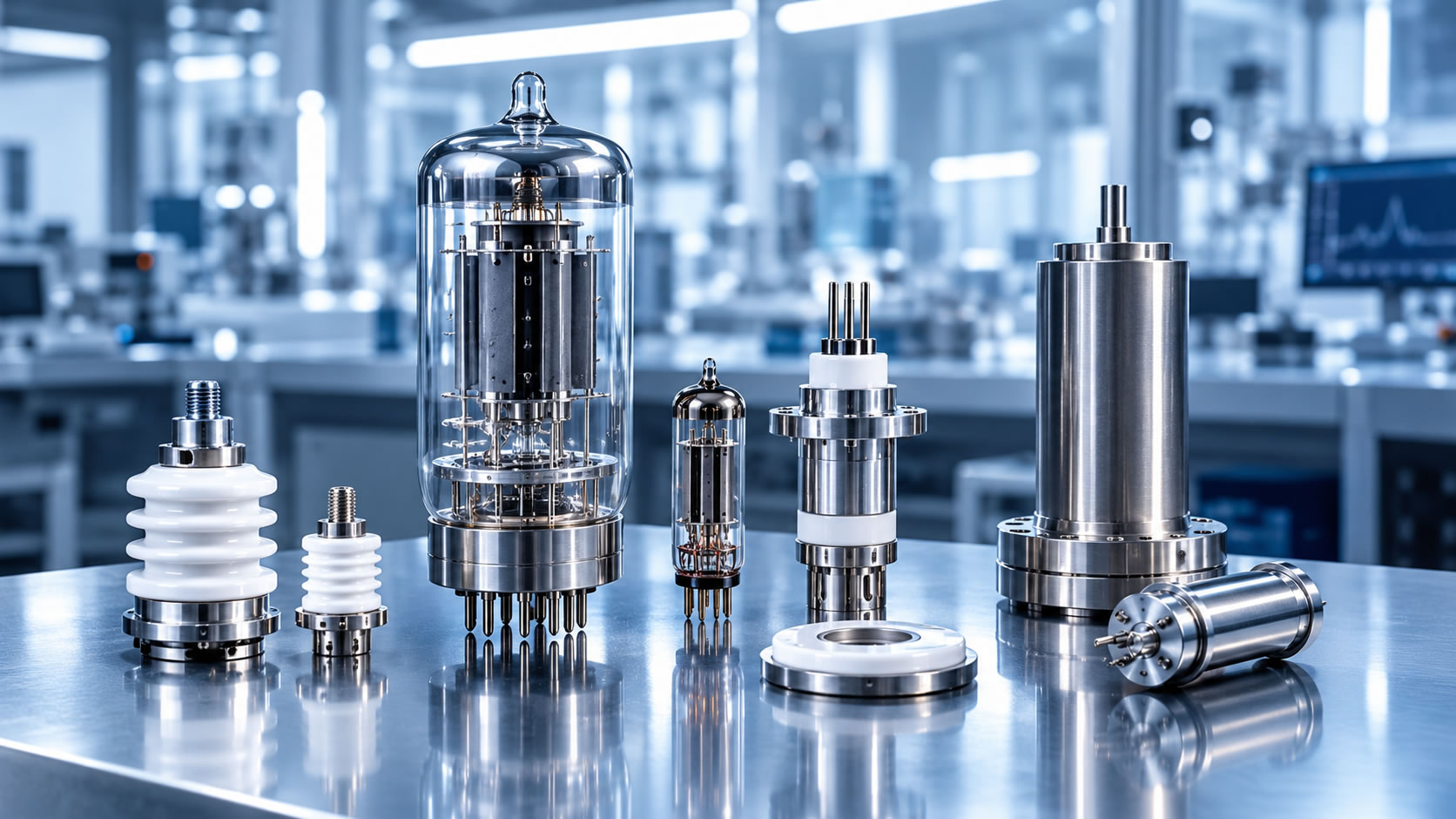
Niobium materials for specialized industrial, chemical-processing and high-temperature applications.
Technical Data

Mechanical Properties of Niobium

The mechanical properties of niobium vary with temperature, material condition and manufacturing process. The following data cover elastic modulus, Vickers hardness and tensile properties under the conditions specified in the original data.

Elastic Modulus of Niobium

Temperature (°C) 25 93 204 310 427 600 800 900
Elastic Modulus (10³ kg/mm²) 12.2 12.3 12.1 11.9 11.8 11.5 11.1 11.0

Test conditions: 1.5 mm plate thickness, 90% deformation, and vacuum annealing at 1100°C for 2 hours under a vacuum of 10-3–10-4 mmHg.

Hardness of Niobium

Temperature (°C) 20 400 600 800 1000 1200
Vickers Hardness (kg/mm²) 175 130 78 65 36 16

Tensile Properties of Niobium

The following data are reported for niobium plate with a thickness of 1 mm. Values are reproduced from the original table; the original source labels the third column “Elastic modulus (kg/mm²).”

Production Method Material Condition Elastic Modulus (kg/mm²)* Elongation (%) Bending Angle
Powder Metallurgy Before annealing
1100°C, 1 hour
63 8.7 <130°
35 37.5 <130°
Powder Metallurgy Before annealing
1100°C, 1 hour
52 9 —
29.5 49.5 —
Electron Beam Melting Before annealing
1100°C, 1 hour
56.3 9 <140°
30.3 51.3 —

*The column heading and the interpretation of the paired values should be verified against the original technical source before using this table for engineering calculations.

Technical Data

Physical Properties of Niobium

Niobium is a refractory metal with a silver-gray luster. Its key physical properties include density, melting point, boiling point, specific heat capacity, thermal expansion coefficient and electrical resistivity. These properties are important when selecting niobium for industrial and high-temperature applications.

Density at 20°C (g/cm³) Melting Point (°C) Boiling Point (°C) Specific Heat Capacity (0–100°C) (J·g⁻¹·K⁻¹) Linear Expansion Coefficient (0–100°C) (10⁻⁶ K⁻¹) Electrical Resistivity at 20°C (μΩ·cm)
8.66 2468 4840 0.272 7.1 13.2

Niobium is a refractory metal with a silver-gray metallic appearance, while niobium powder is typically dark gray. Interstitial elements such as carbon, nitrogen, hydrogen and oxygen can influence its mechanical behavior and ductile-to-brittle transition temperature.

Technical Data

Creep Properties of Niobium

The creep behavior of niobium depends on temperature, applied stress, material condition and oxygen content. The following data show the time required to reach specified creep strains, total creep during testing and oxygen content before and after testing for different niobium material conditions.

Temperature (°C) Stress (kg/mm²) Time to Reach Specified Creep Strain (hours) Total Creep During Test Oxygen Content (%)
0.05% 0.10% 0.20% 0.30% Duration (hours) Creep (%) Before Test After Test
600 (a) 7.9 5 15 35 — 1359 1.08 0.015 <0.1
600 (b) 9.4 40 130 345 1160 — — 0.04 0.19
600 (c) 6.3 50 160 860 2130 5519 0.306 0.04 0.021
700 (c) 1.58 40 290 1590 — 2314 0.22 0.04 0.22
700 (c) 3.15 80 205 650 1495 5008 0.36 0.04 <0.1
700 (c) 4.73 120 220 540 1115 3335 0.4 0.01 <0.1

Notes: (a) Annealed sheet; (b) Processed material; (c) Swaged bar. Dashes indicate values not provided in the original data. Verify the original test conditions and units before using these values for engineering design.

Material Processing

Heat Treatment of Niobium

The heat treatment of niobium and its alloys includes homogenization annealing, stress relief annealing, recrystallization annealing and thermomechanical treatment. They each have their own characteristics and influence each other.

At high temperature, niobium has a strong affinity with oxygen, nitrogen, hydrogen and other elements, and it is easy to form oxides, nitrides, hydrides and other compounds, which will affect mechanical properties and processing properties. Therefore, the heat treatment of niobium and niobium alloys should be carried out in vacuum or under the protection of purified inert gas.

Heat Treatment Process

1. Homogenization Annealing

During melting and casting, due to the rapid cooling rate, the gas in the ingot cannot be removed in time, and the alloy contains unstable phases and segregation and other defects in the crystal. These defects have a great influence on the uniformity and stability of the structure or the process performance, and can be effectively removed by the homogenization annealing treatment.

The homogenization annealing temperature of niobium ingot is 1800~2000℃. The degree of vacuum is mmHg. The holding time depends on the size of the ingot, generally 5 to 10 hours. The changes in gas content and hardness of niobium ingots before and after homogenization annealing are as follows:

Before Annealing After Annealing
Gas Content, % Vickers Hardness
kg/mm²
Gas Content, % Vickers Hardness
kg/mm²
O N O O N O
0.083 0.051 0.002 200 0.05 0.02 0.0018 170-180
0.061 0.035 0.002 190 0.04 0.01 0.018 100-170
0.239 0.0062 - 255 0.097 0.0051 - 187
0.14 0.004 - 260 0.075 0.006 - 190
0.3 0.005 - 255 0.206 0.021 - 200

Note: The repeated O labels and the original table's column headings should be checked against the source table before publication.

Heat Treatment Process

2. Stress Relief Annealing

The deformed metal has higher energy and is in a thermodynamically unstable state. At lower temperatures, a series of changes in tissue and properties occur, called reversion. During the recovery period, only a small part of the energy is released, and the properties of the metal after deformation are only partially recovered. It can be seen that the use of stress relief annealing in the cold working process can continue to process the metal.

The cold working recovery activation energy of niobium and niobium alloys is less than the natural diffusion activation energy, so recovery occurs very quickly at relatively low temperatures. Niobium and most niobium alloys relieve stress and reduce strain energy when heated at a given temperature for 1 hour. Almost all strain centers that create new grains are eliminated.

Reheating and Grain Structure

If reheated to the recrystallization temperature, only equiaxed grains are formed in the remaining strain centers, and in other places, the grains continue to grow, but the cold working direction is maintained.

Application During Cold Working

Niobium and niobium alloys are often subjected to stress relief annealing during cold working.

Heat Treatment Process

3. Recrystallization Annealing

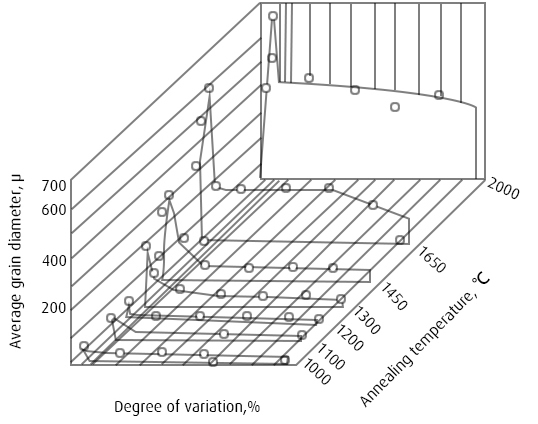
After the deformation, when the metal is heated to a high enough temperature, nucleation and growth are carried out again in the original crystal to form a new crystal without distortion in equilibrium. This process is called recrystallization. After recrystallization, the processing structure of the metal is eliminated, and the mechanical and physical properties are restored to the state before cold deformation. The new crystal has the same crystal structure as the original, but a different phase. Unleashed all potential. The recrystallization temperature of niobium and niobium alloys is mainly related to the degree of deformation and the addition of alloying elements. The pure niobium smelted by electron beam has a cold deformation of 80~85%, and starts to recrystallize at 1070~1100 °C: the deformation amount is 60%, and it starts to recrystallize at 1200 °C. The recrystallization diagram of pure niobium is as follows:

Recrystallization diagram of pure niobium

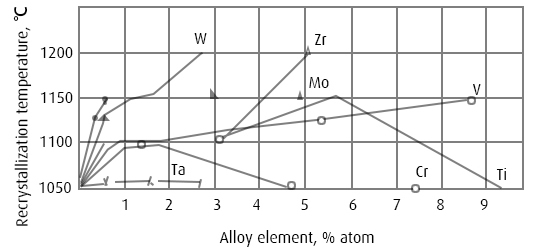
The addition of titanium has little effect on the recrystallization of niobium. The addition of molybdenum and tungsten can greatly increase the recrystallization temperature.

Niobium and niobium alloys undergo recrystallization annealing during rework. Through the interaction of deformation and annealing, the segregation of the ingot can be eliminated; the grains are broken and the structure is uniform; Thereby improving product performance and yield.

The effect of alloying elements on the recrystallization temperature of Niobium
Heat Treatment Process

4. Mechanical Heat Treatment

01 Phase Dissolution
and Aging

Non-uniformly distributed second phases are often seen in the as-cast structure of some alloys. After high temperature annealing treatment, the second phase can be completely or partially dissolved. Most of the second phases in niobium alloys are carbides and oxides of active metals (titanium, zirconium, hafnium, etc.). In addition to dissolving these compounds at high temperatures, precipitation reactions sometimes occur with changes in temperature. Therefore, aging treatment can be performed.

STEP 01 Solid Solution
STEP 02 Cold Deformation
STEP 03 Aging

Because the precipitates are preferentially precipitated on the dislocation lines generated by cold deformation. Therefore, the dispersed strengthening phase can be obtained through “solid solution→cold deformation→aging”, so as to obtain excellent comprehensive properties. This combined treatment is called thermomechanical treatment.

The temperature and time of solution and aging and the amount of intermediate cold deformation have a great influence on product performance. When the solution temperature is low, the supersaturation of the solid solution is not enough; if the solution temperature is too high, the grains are coarse. Excessive aging temperature will result in overaging or recrystallization.

If the amount of intermediate cold deformation is insufficient, the precipitated phase will be discontinuously distributed along the grain boundary, resulting in the cupping brittleness of the product. It can be seen that reasonable selection and strict control of these parameters are very necessary. Also note the interrelationships between them.

Solution or aging is sometimes carried out at the same time as recrystallization, so that many niobium alloys have different degrees of “saddle shape” in the relationship between mechanical properties and annealing temperature. The curve decreases, indicating that the softening effect caused by recrystallization is the main aspect of the contradiction. As the temperature changes, the strength increases and precipitation strengthening dominates.

Niobium · Custom Supply

Request a Quote for Niobium

Tell us your required niobium product form, dimensions, quantity and technical specifications. Our team can help review your requirements and provide a suitable supply solution for your application.

Contact AlloyHit →
Applications

Applications of Niobium

Niobium is a versatile functional material used across a wide range of industries, including electronics, steelmaking, metallurgy, chemical processing, nuclear energy, aerospace, and superconducting technology.

Applications of niobium in steelmaking, metallurgy and industrial materials
01

Steel & Metallurgy

Niobium is used in steelmaking, metallurgy and advanced material production, making it relevant to industrial applications that require specialized material properties.

  • Steelmaking
  • Metallurgical applications
  • Cemented carbide production
  • Ceramic materials
Niobium applications in electronic devices and vacuum tube technology
02

Electronics & Vacuum Technology

Niobium's thermionic emission properties support its use in selected vacuum electronic applications and specialized electronic components.

  • Getters for vacuum tubes
  • Low-pressure rectifiers
  • Vacuum electronic devices
  • Cryogenic electronic systems
Niobium applications in nuclear energy
03

Energy & Advanced Technology

Niobium is used in nuclear energy, aerospace, superconducting technology and scientific research, where its material properties support specialized technical applications.

  • Nuclear energy applications
  • Aerospace technology
  • Superconducting technology
  • Scientific and medical equipment
Why AlloyHit

Why Choose AlloyHit for Niobium?

AlloyHit is a professional Chinese manufacturer and exporter of high-purity niobium metal and niobium alloy products, supplying niobium sheet, plate, rod, bar, foil, strip, tube, pipe and niobium wire for global buyers across Europe, North America, Japan, South Korea and other worldwide markets. We specialize in refractory rare metal production by powder metallurgy, vacuum consumable arc melting (VAR) and electron-beam melting (EB) to produce consistent-quality niobium material for aerospace, nuclear energy, superconducting technology, chemical corrosion-resistant equipment, medical devices, electronics and metallurgy industries.

Strict Purity & Impurity Control

We produce pure niobium from 99.9% up to 99.99% purity. Interstitial impurities including oxygen, carbon, hydrogen and nitrogen are tightly controlled, avoiding hard-brittle failure caused by trace contaminations. Our niobium conforms to ASTM B394 industrial standard, with full material test reports (MTR) supplied for every batch.

Complete Product Forms & Flexible Custom Manufacturing

We deliver standard niobium sheet / plate, niobium rod / bar, niobium foil / strip, niobium tube / pipe, niobium wire, as well as custom-machined niobium parts according to customer drawings or samples. We support small trial-order and large-volume long-term contract orders, covering different thickness, diameter, tolerance and annealing status (annealed / cold-worked) requirements.

Advanced Melting & Heat-Treatment Capability

Our workshop is equipped with high-temperature vacuum sintering furnaces, electron-beam furnaces and vacuum annealing systems. Niobium homogenization annealing, stress-relief annealing and recrystallization annealing are completed under high vacuum environment to prevent oxygen/nitrogen contamination, guaranteeing good ductility, cold-workability and low plastic-brittle transition temperature of niobium products.

Global Export Service & Technical Material-Selection Support

Our metallurgical engineering team provides free technical consultation for niobium material selection, welding, forming and high-temperature application problems. We handle export documentation, seaworthy vacuum-sealed wooden-case packaging for overseas shipment. Fast quotation reply via email or website inquiry form for worldwide importers, research labs and industrial end-users.

Competitive Factory-Direct Price & Reliable Lead Time

As original manufacturer without middlemen markup, AlloyHit offers cost-effective high-purity niobium raw material. Standard niobium stock items can be shipped quickly; custom niobium products have clear production scheduling and predictable delivery cycles. If you are sourcing a reliable niobium refractory metal supplier for your project, please leave your message or email us for a detailed quotation, specification sheet and sample support.

Visit our official niobium page: https://www.alloyhit.com/niobium.html.

MATERIAL COMPARISON

Niobium vs Similar-Performance Refractory Metals

When engineers and procurement specialists select refractory metals for high-temperature, cryogenic, chemical corrosion and vacuum applications, niobium is frequently evaluated alongside tantalum, titanium and molybdenum. The following comparisons cover physical properties, ductility, corrosion behavior, working limits, advantages, limitations and recommended application scenarios to help guide material selection.

01 METAL COMPARISON

Niobium vs Tantalum

Niobium (Nb) and tantalum (Ta) are both group V refractory rare metals with excellent ductility and strong acid corrosion resistance, which is why they are often considered interchangeable for many chemical and vacuum projects. Tantalum has a much higher melting point at 3017°C versus niobium’s 2468°C, and its density reaches 16.6 g/cm³, nearly double niobium’s 8.66 g/cm³. Tantalum delivers superior corrosion resistance in aggressive acidic environments, including hydrochloric acid and sulfuric acid, and it maintains outstanding chemical stability under severe corrosive media. Tantalum also features good biocompatibility for medical implant components.

However, tantalum raw material cost is significantly higher than niobium, and its high density adds extra weight to finished parts. Niobium has lower density, better cost performance and lighter weight. It can be used as an economical substitute for tantalum in vacuum, cryogenic, superconducting and moderate corrosion environments. Niobium still resists most mineral acids, but its corrosion performance drops in extremely strong corrosive conditions where tantalum is required. Both metals must avoid hydrofluoric acid. Both niobium and tantalum can be cold rolled, stamped and formed easily, and both are sensitive to oxygen, nitrogen and hydrogen contamination at elevated temperatures.

Selection Guidance

Choose tantalum if your component faces highly corrosive acid media. Choose niobium to reduce weight and material cost for vacuum equipment, superconducting magnets, and moderately corrosive chemical vessels. AlloyHit supplies both high-purity niobium and tantalum products including sheet, plate, rod, foil, tube and wire.

02 METAL COMPARISON

Niobium vs Titanium

Niobium and titanium are both ductile metals widely used in aerospace, chemical equipment and medical fields, but they belong to different material families with very different high-temperature limits. Titanium (Ti) is a lightweight structural metal with density only 4.51 g/cm³, much lighter than niobium. Titanium has good general corrosion resistance and excellent biocompatibility, with relatively low raw material cost. Its melting point is 1668°C, far lower than niobium’s 2468°C.

Titanium cannot sustain long-term service above 500°C, and will oxidize rapidly at higher temperature. Niobium is a true refractory metal and can work under vacuum or inert atmosphere at much higher temperatures. Niobium retains good ductility at cryogenic temperatures and exhibits unique superconducting properties that titanium does not have. Compared to titanium, niobium has higher density and higher raw material price. Niobium also shows better resistance to many liquid metals.

Selection Guidance

Select titanium for lightweight structural parts working below 500°C, such as aerospace frames and general medical implants. Select niobium for vacuum high-temperature components, cryogenic devices, superconducting parts, and equipment exposed to liquid metal corrosion. AlloyHit manufactures high purity niobium sheet, rod, foil and custom machined niobium components for these high-end applications.

03 METAL COMPARISON

Niobium vs Molybdenum

Niobium (Nb) and molybdenum (Mo) are both refractory metals for high-temperature furnace and vacuum industry, while their room-temperature ductility differs greatly. Molybdenum has a melting point of 2623°C, slightly higher than niobium, with density of 10.2 g/cm³. Molybdenum owns excellent high-temperature strength and good thermal conductivity. It is widely used for furnace liners, heat shields and sputtering targets. The biggest weakness of molybdenum is room-temperature brittleness after heavy cold working. Molybdenum oxidizes quickly in air when temperature exceeds 600°C.

Niobium features exceptional room-temperature ductility and excellent cold workability. Annealed pure niobium can achieve elongation of 30–50%, which is far better than molybdenum. Niobium has a very low ductile-brittle transition temperature and stays ductile even under cryogenic conditions. But niobium’s high-temperature tensile strength is lower than molybdenum, and niobium is also prone to oxygen and nitrogen contamination at high temperature in air.

Selection Guidance

Choose molybdenum for components requiring high strength above 1200°C in vacuum furnaces, if you can accept brittleness. Choose niobium when you need refractory metal that can be easily cold formed, bent and stamped into complex shapes, especially cryogenic and superconducting assemblies. AlloyHit provides vacuum melted niobium material with strict interstitial impurity control.

If you need help to decide between niobium, tantalum, titanium or molybdenum for your project, contact AlloyHit via the website inquiry form or email. Our metallurgical engineers will provide professional material selection suggestions and quotation. Visit https://www.alloyhit.com/niobium.html to submit your requirements.

Frequently Asked Questions

Frequently Asked Questions About Niobium

Q1: What Is Niobium (Columbium)? What Are Its Main Properties?

A: Niobium (chemical symbol Nb, also historically known as columbium) is a silver-gray refractory metal with a melting point of approximately 2,468°C. It features low vapor pressure, excellent cold-working ductility, resistance to many acidic and alkaline environments and certain liquid metals, a low ductile-to-brittle transition temperature, and superconducting properties in suitable conditions. Interstitial elements such as oxygen, hydrogen and carbon can make niobium harder and more brittle, so impurity control is critical to material quality. Common product forms include niobium sheet, plate, rod, bar, foil, tube and wire.

Q2: What Production Methods Does AlloyHit Use for Niobium Material?

A: AlloyHit uses three production technologies for niobium materials: high-temperature vacuum sintering through powder metallurgy, electron-beam melting (EB), and vacuum consumable-electrode arc remelting (VAR). The appropriate production route depends on the required purity, material structure, product form and mechanical performance.

Q3: What Atmosphere Is Required for Niobium Heat Treatment?

A: Niobium can react with oxygen, nitrogen and hydrogen at elevated temperatures. Homogenization annealing, stress-relief annealing and recrystallization annealing of niobium and niobium alloys should be performed under vacuum or suitable purified inert-gas protection. Otherwise, contamination and the formation of oxide, nitride or hydride phases may adversely affect ductility and other material properties.

Q4: What Is the Recrystallization Temperature of Pure Niobium?

A: The recrystallization temperature of pure niobium depends strongly on the degree of prior cold deformation and the material's processing history. For electron-beam-melted pure niobium, the supplied technical information indicates that recrystallization begins at approximately 1,070–1,100°C after 80–85% cold deformation, while the onset rises to approximately 1,200°C after 60% cold deformation. Molybdenum or tungsten additions can significantly raise the recrystallization temperature, while titanium has a more limited influence. Actual values depend on composition and processing conditions.

Q5: What Industries Use AlloyHit Niobium Products?

A: Niobium products are used in aerospace components, nuclear-energy equipment, superconducting magnets, chemical corrosion-resistant equipment, vacuum-tube getters, cryogenic devices, selected medical components, metallurgy and scientific research. The appropriate niobium grade and product form depend on the application's operating environment and technical requirements.

Q6: Can AlloyHit Supply Custom-Size Niobium Parts? What About Minimum Order Quantities?

A: AlloyHit can discuss custom-size niobium products and components manufactured according to customer drawings or samples, including cutting, stamping and simple CNC machining where available. Small trial orders for laboratory use and larger-volume industrial orders can be discussed. Contact us with your drawing, purity requirements, dimensions and target quantity to confirm feasibility and obtain a quotation.

Q7: What Documents Can AlloyHit Provide for Niobium Shipments?

A: Depending on the product and order requirements, available documentation may include a material test report (MTR), chemical-composition certificate, dimensional inspection records and export documentation. Please confirm the required documents when requesting a quotation.

Q8: How Long Is the Lead Time for Niobium Orders?

A: The supplied lead-time estimates are 7–14 working days for standard niobium sheet, rod or wire available from stock, and approximately 20–40 working days for custom high-purity materials, special-dimension niobium tubes or complex machined components. Actual lead times depend on stock availability, product specifications, manufacturing complexity and the production schedule. Please confirm the delivery estimate with AlloyHit before placing an order.

Q9: What Information Should I Provide When Requesting a Niobium Quotation?

A: Please specify the required purity grade, product form (sheet, plate, rod, bar, foil, strip, tube, pipe or wire), dimensions (thickness, diameter, length and tolerances), material condition (annealed or cold-worked), order quantity, any special impurity limits and intended application. Drawings, technical specifications and inspection-document requirements are also helpful when available.

Niobium · Custom Supply

Request a Quote for Niobium

Tell us your required niobium product form, dimensions, quantity and technical specifications. Our team can help review your requirements and provide a suitable supply solution for your application.

Contact AlloyHit →